
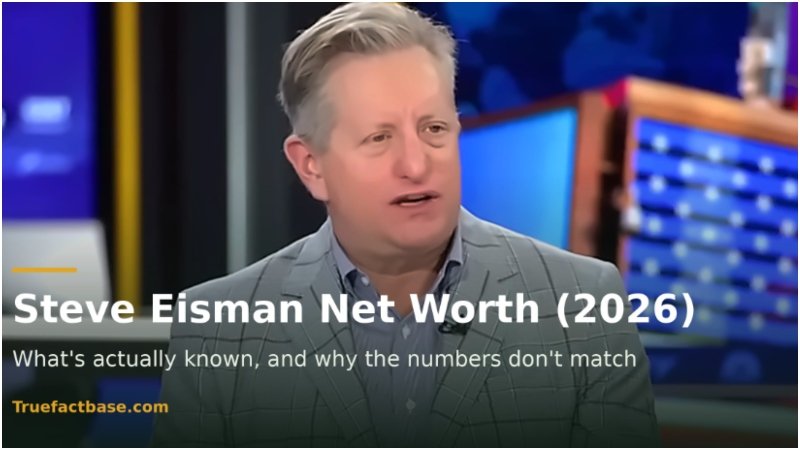
Search for Steve Eisman net worth, and you will quickly run into a problem: the numbers do not agree.
Some websites put his wealth in the tens of millions. Others claim hundreds of millions, while a few suggest he could be worth more than $1 billion. The problem is not simply that the estimates are different. It is that many of them do not explain where their numbers came from.
Eisman is a private investor, not a publicly traded company executive whose stock holdings can be calculated from regulatory filings. He has never published a personal balance sheet or confirmed a specific net-worth figure.
That means the most responsible answer is also the least dramatic: Steve Eisman’s exact net worth is not publicly known in 2026.
What is known is much more interesting. Eisman built a long career in financial research and investing and became internationally recognized after betting against parts of the U.S. mortgage market before the 2008 financial crisis. His story later became one of the real-life foundations of Michael Lewis’s The Big Short and the 2015 film starring Steve Carell.
Quick Answer: What Is Steve Eisman Net Worth?
Steve Eisman Net Worth has not been publicly confirmed.
Numerous online estimates vary widely and generally lack enough evidence to support a reliable figure. His career has included investment research, hedge fund management, portfolio management, and other financial work, but the value of his personal assets and investments has not been disclosed.
For that reason, giving one exact dollar amount would create a false sense of certainty.
The safest conclusion is that Eisman has accumulated substantial wealth during a long career in finance, but there is no verified public figure for his net worth in 2026.
Steve Eisman at a Glance
| Detail | Information |
|---|---|
| Born | 1962, New York City |
| Education | University of Pennsylvania; Harvard Law School |
| Known for | Betting against subprime mortgage-related investments before the 2008 crisis |
| Best-known portrayal | Mark Baum in The Big Short, played by Steve Carell |
| Earlier major fund role | Partner and Senior Portfolio Manager at FrontPoint |
| Current public work | Financial commentary and The Real Eisman Playbook podcast |
Eisman’s professional background includes a BA from the University of Pennsylvania and a JD from Harvard Law School. He later worked in financial research before moving into portfolio management.
Why Steve Eisman Net Worth Estimates Are So Different
The biggest problem with celebrity-style net-worth websites is the lack of transparent methodology.
One site may publish an estimate without showing its calculation. Another website may repeat that number as though it were independently verified. Over time, the same figure can appear across dozens of pages even though none of them has access to Eisman’s private financial records.
That is especially important with hedge fund managers.
A public-company founder may have a disclosed ownership stake that gives researchers something concrete to calculate. A private investor’s wealth can be much harder to measure. It may include investments, compensation, fund interests, property, and other assets that are not publicly reported in one convenient place.
Eisman’s career makes the problem even more complicated. He has worked at several financial firms and managed investment capital over many years. Knowing the size of a fund does not tell you how much money the manager personally earned from it.
There is another common source of confusion: websites sometimes attach a familiar financial publication’s name to an unsupported number. A claim becomes more believable simply because a famous publication is mentioned, even when the page provides no source.
That is not enough evidence.
A net-worth estimate should be treated cautiously unless the underlying information is public, specific, and independently verifiable.
How Steve Eisman Built His Wealth
Eisman’s career began with financial research rather than celebrity.
After graduating from the University of Pennsylvania and Harvard Law School, he moved into Wall Street and developed a reputation as a detailed financial analyst. He worked at Oppenheimer and later Chilton Investment Company before becoming more directly involved in portfolio management.
His attention to financial companies eventually led him toward the mortgage and consumer-credit industries.
During the housing boom, Eisman became increasingly skeptical of the quality of loans being made to borrowers with weaker credit. He believed the risks inside the mortgage system were much larger than many investors recognized.
That skepticism became the foundation of his most famous investment thesis.
Eisman later became a partner and senior portfolio manager at FrontPoint, where he ran financial-services strategies. He and his team positioned for a decline in mortgage-related investments as their concerns about the housing market grew.
When the housing and credit markets deteriorated, those positions became enormously valuable.
The trade turned Eisman into one of the most recognizable investors associated with the 2008 financial crisis.
His career did not end there. He later founded Emrys Partners before joining Neuberger Berman in 2014. Public biographies have described him as a managing director and portfolio manager there. However, because he was placed on indefinite leave from Neuberger Berman in 2024, it is better not to describe the firm as his current employer without qualification.
By 2026, Eisman is also active through his financial commentary and The Real Eisman Playbook, which publishes regular episodes about markets, companies, and economic issues.
The Investment Trade That Made Him Famous
Eisman’s reputation was built largely on his decision to challenge the conventional view of the housing market.
In the years before the financial crisis, mortgage lending had expanded rapidly. Subprime loans became an important part of the system, while mortgage-related securities were widely traded throughout the financial industry.
Eisman studied the businesses behind those loans and became convinced that the risks were being underestimated.
His investment thesis was not simply a prediction that house prices might fall. He focused on the financial companies and mortgage structures that he believed were especially vulnerable if borrowers began defaulting at higher rates.
That distinction matters.
The housing market eventually deteriorated, mortgage defaults increased, and major parts of the financial system came under extreme pressure. Eisman’s positions against mortgage-related investments produced major gains and established his reputation as a contrarian investor.
It is one reason his name remains closely associated with the financial crisis more than a decade later.
Steve Eisman and The Big Short
For many people, Steve Eisman is better known through Hollywood than through Wall Street.
Michael Lewis featured Eisman’s story in his 2010 book The Big Short: Inside the Doomsday Machine. The 2015 film adaptation then introduced the story to a much larger audience.
Steve Carell played a character named Mark Baum, who was based on Eisman. The film changed names and reshaped some details for storytelling, but the character’s central investment story was drawn from Eisman’s real experience.
That distinction is important when researching Eisman’s biography.
Mark Baum is not Eisman’s real name. He is a fictionalized film character based on a real investor.
The movie also presents events through a dramatic Hollywood lens. Some conversations, personalities, and scenes were compressed or altered to make the story work on screen.
The broader financial story, however, is rooted in the real events surrounding the mortgage crisis.
Did The Big Short Make Steve Eisman Richer?
There is no reliable public evidence showing that the movie itself dramatically increased Eisman’s personal wealth.
What it certainly changed was his public profile.
Before the film, Eisman was well known among investors and people who followed Wall Street. After its release, millions of moviegoers learned his story without ever having followed financial markets.
That kind of visibility can create opportunities for interviews, speaking engagements, media appearances, and other professional work. But increased fame should not automatically be converted into a specific dollar amount.
There is no public accounting that shows how much additional wealth Eisman personally gained because of the movie.
Where Does Steve Eisman’s Money Come From?
This is where careful wording matters.
Because Eisman has not publicly disclosed his complete finances, it is impossible to produce a verified breakdown of his personal income.
His professional career has included financial analysis, hedge fund management, and portfolio management. Those roles can provide income through compensation, investment-related fees, or performance-linked arrangements, depending on the structure of the position.
His successful mortgage-market trade also played an important role in his financial history. Contemporary reporting has described the trade as highly profitable for the investors and firm involved.
Over a career lasting decades, personal investments can also become an important part of an investor’s wealth.
Eisman has remained active in financial commentary as well. His podcast, The Real Eisman Playbook, was publishing weekly episodes in 2026, giving him another public platform focused on markets and investing.
What cannot be done responsibly is take these different sources of income and add imaginary numbers together.
Without private financial records, any precise total remains an estimate.
What Investors Can Learn From Steve Eisman’s Career
Eisman’s career offers several useful lessons, even if you have no interest in copying his trades.
One lesson is the importance of independent research. His reputation was built partly on questioning assumptions that many other market participants accepted.
Another is the value of looking beyond headlines. Financial problems can remain hidden when investors focus only on broad market trends instead of examining how companies actually make money.
His career also shows why debt deserves careful attention. Businesses and financial systems can appear healthy during periods of easy credit. When borrowing conditions change, weaknesses that were previously overlooked can become much more visible.
Finally, timing matters.
An investor can identify a real problem and still lose money if the position is taken too early, too aggressively, or without enough risk management. Eisman’s famous trade is often remembered for its outcome, but successful investing involves surviving the period between identifying a thesis and seeing whether it proves correct.
These are general investing observations, not personalized financial advice.
How to Judge a Celebrity Net Worth Estimate
The next time you see a celebrity or investor net-worth number online, do not assume that repetition makes it accurate.
Start by asking where the number originated.
When checking a net worth estimate, look for a clear source behind the number. Make sure the cited source actually supports the figure, and check whether the website explains how the estimate was reached. It is also important to see when the information was published or last updated, since older figures may no longer reflect the person’s current financial situation.
Is the information recent?
You should also distinguish between company assets, fund assets, and personal wealth. They are not interchangeable.
For someone like Eisman, this distinction is especially important. Managing billions of dollars for clients would not mean the manager personally owns billions.
If a website simply publishes a precise number without explaining how it arrived at that figure, treat it as an estimate rather than a fact.
FAQs
What is Steve Eisman Net Worth?
Steve Eisman’s exact net worth is not publicly confirmed. Online estimates vary widely, but there is not enough reliable public information to establish one precise figure.
Is Steve Eisman a billionaire?
There is no reliable public evidence that allows his personal wealth to be confirmed at $1 billion or more. Claims that he is a billionaire should therefore be treated as unverified.
How did Steve Eisman make his money?
Eisman’s wealth is associated with his long career in financial research, portfolio management, and investment management. He became especially well known for profitable positions against mortgage-related investments before the 2008 financial crisis.
Is Mark Baum a real person?
No. Mark Baum is the fictionalized character played by Steve Carell in The Big Short. The character is based on real investor Steve Eisman.
What does Steve Eisman do now?
In 2026, Eisman remains active as a financial commentator and host of The Real Eisman Playbook, a weekly podcast covering markets and economic issues.
Did Steve Eisman really predict the 2008 financial crisis?
Eisman was among the investors who identified serious problems in the subprime mortgage market before the broader financial crisis unfolded. He positioned against mortgage-related investments and later became one of the best-known investors associated with the trade.
Is Steve Eisman’s wealth publicly known?
No. There is no publicly verified personal balance sheet that establishes his exact net worth.
Final Thoughts
The most interesting thing about Steve Eisman Net Worth’ wealth may be that nobody can responsibly put an exact number on it.
His financial career is well documented in broad terms. He built a reputation as a detailed analyst, challenged the optimism surrounding subprime lending, and became famous after positioning against mortgage-related investments before the 2008 crisis.
His story later reached a global audience through The Big Short, with Steve Carell portraying the fictionalized character Mark Baum.
But fame does not create a public balance sheet.
So when you see a website confidently claiming that Steve Eisman is worth $20 million, $300 million, or more than $1 billion, the right question is not which number sounds most believable.
Ask a simpler question:
What is the evidence?
Unless a reliable source can answer that question, Steve Eisman’s exact net worth should remain classified as unknown.
Last updated: October 2026. Steve Eisman’s personal net worth has not been publicly verified. This article is for informational purposes only and is not financial or investment advice.